I build metals into oxidation states and bonding motifs they aren't supposed to hold.
My research, conducted in the Fortier Laboratory at UTEP under Prof. Skye Fortier, centers on low-valent and multiply-bonded early transition metal complexes — chemistry that sits outside the conventional stability window for these elements. This includes a titanium chalcogenide series spanning the Ti(IV)/Ti(III) redox couple across E = N, O, S, Se, and Te, masked Zr(II) synthons stabilized against disproportionation, and a rare linear Fe(II) complex supported by imidazolin-2-iminato ligands. Most of what I make cannot survive light, air, or a careless breath of moisture, so it is born and lives entirely on the Schlenk line and behind glovebox glass.
Every new compound is characterized as completely as the chemistry demands: single-crystal X-ray diffraction to confirm structure and bond order, multinuclear NMR — including paramagnetic systems — to probe solution behavior, and EPR for electronic structure.
Outside the glovebox, I write the software that speeds this work up — turning repetitive, time-consuming data processing into something faster and more intuitive. Time in this field is finite and rarely forgiving, and I'd rather spend it on the chemistry.
Curriculum vitae
Education, research and teaching experience, presentations, and awards — the full record in one PDF. Last updated 2026
Download CV (PDF)Publications
-
Crystal and Molecular Structure of Guaiazulene and Its Potassium Crown Ether Salt: A Conglomerate
Crystal Growth & Design 2025, 25 (12), 4178–4184. DOI: 10.1021/acs.cgd.4c01760
-
Porphyrin-functionalized glassy carbon electrodes for electrochemical water splitting
Dalton Transactions 2025, 54 (33), 12550–12556. DOI: 10.1039/D5DT01390A
-
Low Cost Electrochemical PGE Platform for Sensitive Determination of Pb(II) and Cd(II)
ECS Transactions 2023, 110 (1), 255–272. DOI: 10.1149/11001.0255ecst
In preparation
- Titanium(IV)/Titanium(III) chalcogenide complexes across the E = N, O, S, Se, Te series: synthesis, electrochemistry, and electronic structure — M. Saucedo, et al.; S. Fortier
- A linear bis(imidazolin-2-iminato) iron(II) complex: synthesis and electronic structure — M. Saucedo, et al.; S. Fortier
Full and updated list: orcid.org/0000-0003-1312-6633
Skills & techniques
Ligand synthesis
Organic Synthesis of Ancillary Ligands
Design and synthesize ancillary ligands — NHC-based imidazolin-2-iminato and guanidinate — for early transition metal and iron complexes.
NMR
Nuclear Magnetic Resonance
Acquire and interpret multinuclear NMR of air-sensitive samples (1H, 2H, 13C, 7Li, 11B, 19F, 29Si, 31P) and 2D COSY/HSQC, including paramagnetic complexes.
Glovebox
Glovebox Operation & Maintenance
Operate and maintain inert-atmosphere gloveboxes, keeping O2 and H2O below 1 ppm through routine monitoring and careful antechamber transfers.
scXRD
Single-Crystal X-Ray Diffraction
Solve structures independently, from growing and mounting air-sensitive crystals through data collection and refinement (APEX4, SAINT, SADABS, SHELXL, Olex2, PLATON).
CV
Cyclic Voltammetry
Measure cyclic voltammetry of air-sensitive complexes and assess reversibility and diffusion with Randles–Ševčík analysis.
EPR
Electron Paramagnetic Resonance
Acquire, interpret, and simulate EPR spectra of paramagnetic transition metal complexes using EasySpin in MATLAB, with hands-on experience on Ti(III) and Fe(II) systems.
Schlenk
Air-Free Schlenk-Line Techniques
Synthesize and handle air-, moisture-, temperature-, and light-sensitive compounds under rigorously inert conditions.
Data analysis
Custom Data-Processing Software
Write Python and MATLAB tools that automate processing of spectroscopic, electrochemical, and crystallographic data — NMR, EPR, scXRD, and CV — from raw files to publication-ready results.
Hover over (or tap) a technique for details.
- 01 Single-crystal X-ray diffraction — independent, crystal growth through refinement (APEX4, SAINT, SADABS, SHELXL, Olex2, PLATON)
- 02 Air-, moisture-, temperature-, and light-sensitive synthesis (Schlenk line, glovebox)
- 03 Electrochemistry — cyclic voltammetry, Randles–Ševčík analysis; two publications in this area
- 04 Multinuclear NMR of diamagnetic and paramagnetic complexes (1H, 2H, 13C, 7Li, 29Si, 11B, 19F, 31P; COSY, HSQC)
- 05 EPR spectroscopy — acquisition and simulation of Ti(III)/Fe(II,III) spectra (EasySpin/MATLAB)
- 06 X-ray absorption spectroscopy (XANES) — trained user, NSLS-II, Brookhaven National Laboratory
- 07 Ligand design and organic synthesis — NHC-based imidazolin-2-iminato and guanidinate ligands
- 08 Scientific computing — Python and MATLAB tools for spectroscopic and electrochemical data processing
Programs I've written
-
ORTEPSauce
Opens .cif, .ins, and .res files and draws structures in ORTEP style with thermal ellipsoids. Exports publication-quality images and rotating GIFs, with shadows and reflections reserved for the final POV-Ray-style render so the live view stays fast.

Download for Windows Source on GitHub
Saucedo Cañas, M. A.; Fortier, S. ORTEPSauce [Computer software]; Zenodo, 2026. DOI: 10.5281/zenodo.24170231
-
SauCV
Processes cyclic voltammetry data and runs Randles–Ševčík analysis — built to speed up routine electrochemical workup in the group.
-
SauceNMR
A desktop tool that takes raw Bruker FIDs to finished spectra: Fourier transform, phasing, solvent referencing, integration, multiplet and J analysis, baseline correction, and impurity detection, ending in SI-ready report text and publication-quality figures. Built for the air-sensitive dia- and paramagnetic complexes the group works with.
-
EasierSpin
A graphical front end for EasySpin: set up spin systems, isotopes, g and hyperfine tensors, linewidths, and multi-component fits in a form, and it writes the simulation- and fitting-ready MATLAB script for you.
Crystal structures
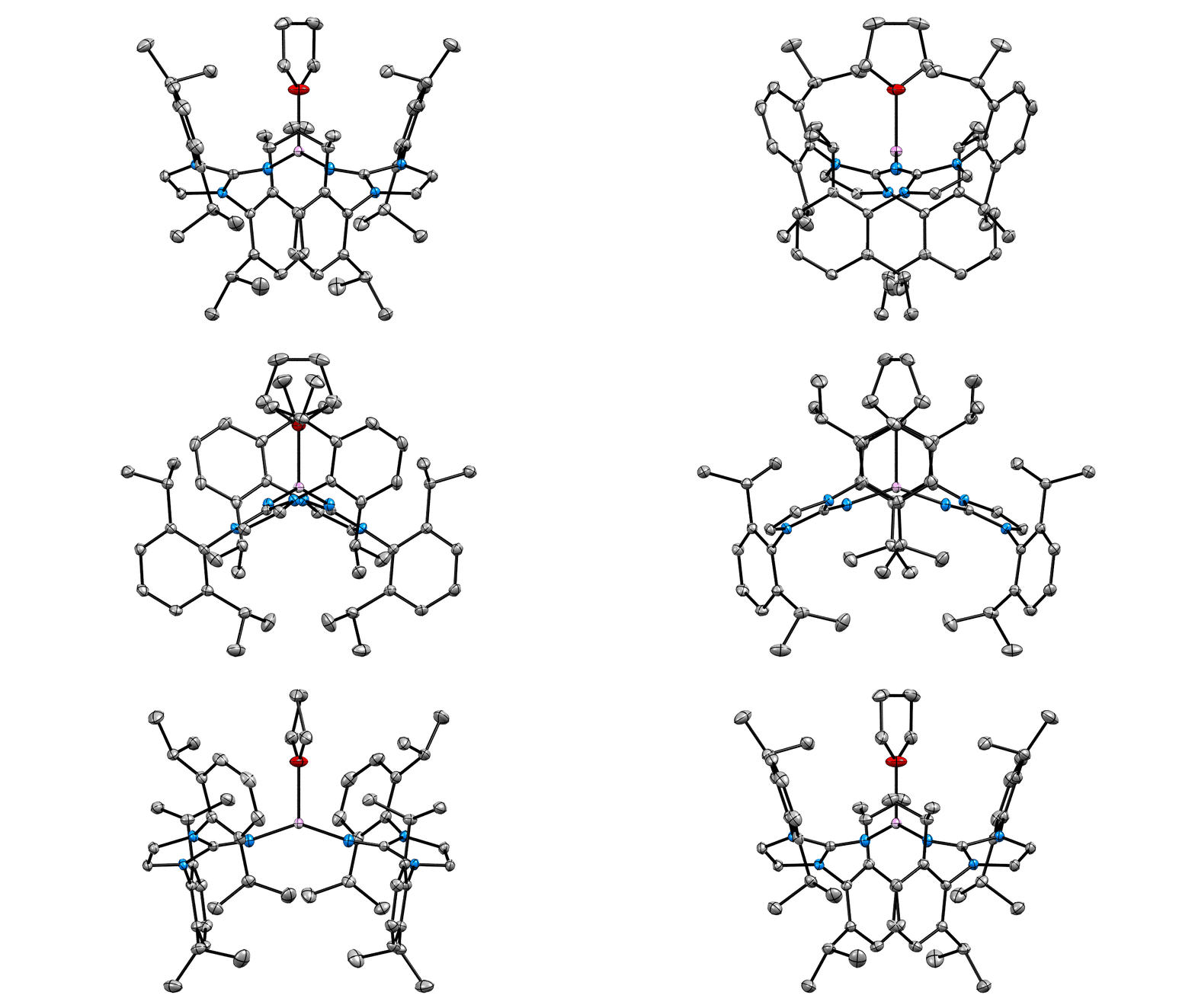
Solid-state structures from my work, rendered with thermal ellipsoids at 50% probability.